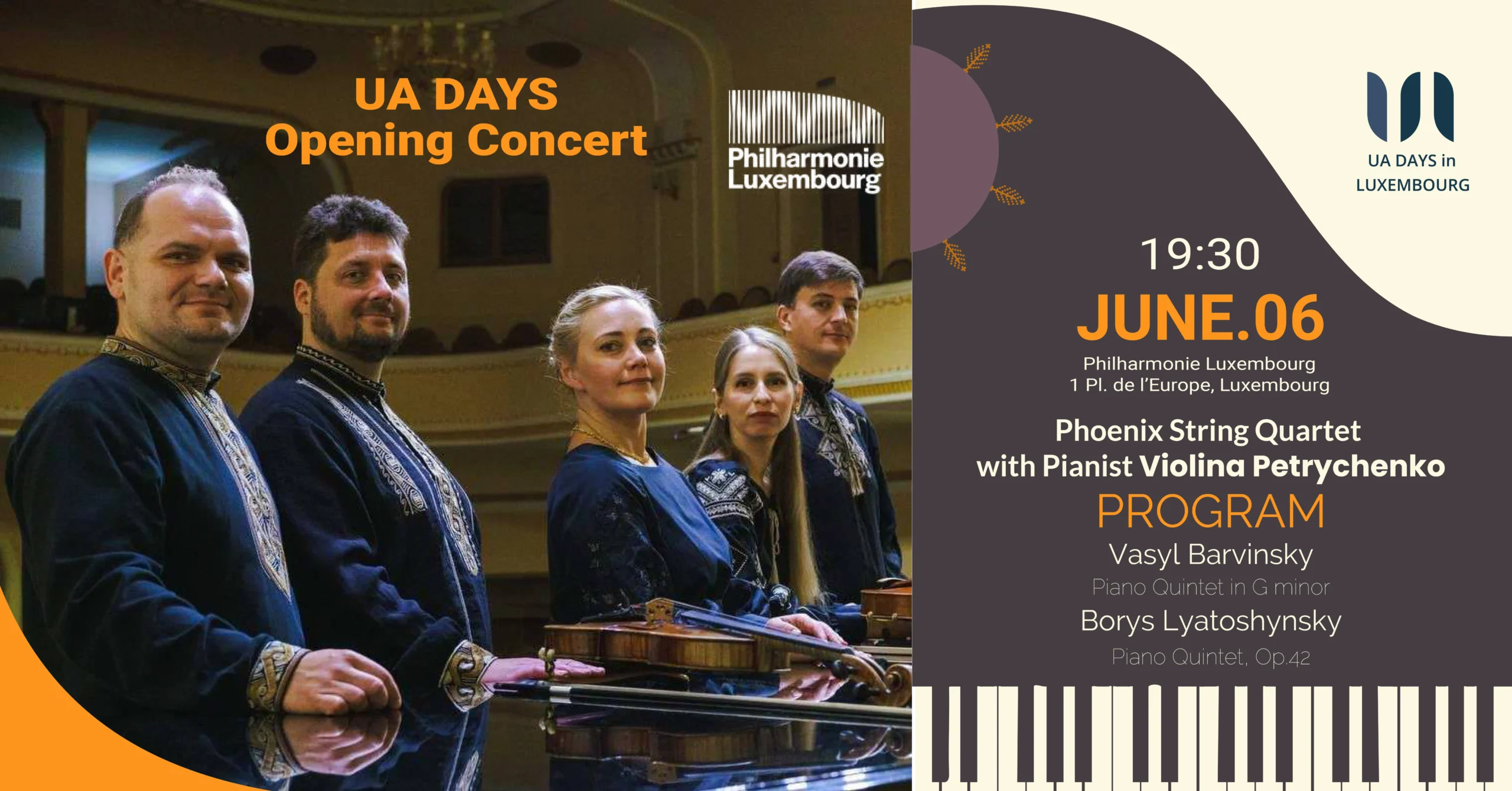
Phoenix String Quartet with pianist Violina Petrychenko
The Phoenix String Quartet, founded in 2006 in Lviv, Ukraine, brings together graduates of the Mykola Lysenko Lviv National Music Academy:
- Mykola Havyuk, Violin
- Petro Titiaiev, Violin
- Anna Bura, Viola
- Denys Litvinenko, Cello
The ensemble has performed at numerous international chamber music festivals and has been awarded the prestigious Liudkevych Prize for its artistic excellence. Since 2023, Violina Petrychenko has joined the quartet as a pianist, expanding it into a quintet to introduce Ukrainian chamber music to a broader audience.

Violina Petrychenko, born in Zaporizhzhia, studied in Kyiv, Weimar, Cologne, and Essen. She has released six albums featuring works by 20th-century Ukrainian composers, earning multiple Opus Klassik nominations. As the artistic director of the “Sounds of Ukraine” festival and a soloist with the Lviv Philharmonic, she is passionately dedicated to promoting Ukrainian music worldwide.
Program: Piano Quintets by Vasyl Barvinsky and Borys Lyatoshynsky
This evening’s program highlights two of Ukraine’s most important composers, whose music blends national identity with universal emotions.
Vasyl Barvinsky (1888–1963)
The Piano Quintet in G minor, composed around 1912, is one of the most significant Ukrainian chamber music works of the early 20th century.
- The first movement, Grave, quasi sospitando, sets a dark and searching tone, filled with expressive lamenting motifs.
- The second movement, Allegro non troppo, contrasts dramatic passages with folk-inspired elements.
- The final movement, Prayer, is a deeply spiritual Adagio, imbued with solemn beauty.
After Barvinsky was arrested by the Soviet regime, his manuscripts were destroyed. He later reconstructed the quintet from memory—an act of artistic resilience and devotion to his homeland.
Borys Lyatoshynsky (1895–1968)
The Piano Quintet, Op. 42, composed in 1942 during Lyatoshynsky’s wartime evacuation, is often referred to as the “Ukrainian Quintet.” It is a deeply passionate work, filled with yearning, hope, and resilience. Despite the backdrop of war, the music conveys a sense of inner peace and poetic depth. The four movements—Allegro e poco agitato, Lento e tranquillo, Allegro, and Allegro risoluto—demonstrate Lyatoshynsky’s mastery in balancing drama with lyrical introspection.
With the 130th anniversary of Lyatoshynsky’s birth approaching in 2025, his music is gaining increasing recognition across European concert halls.