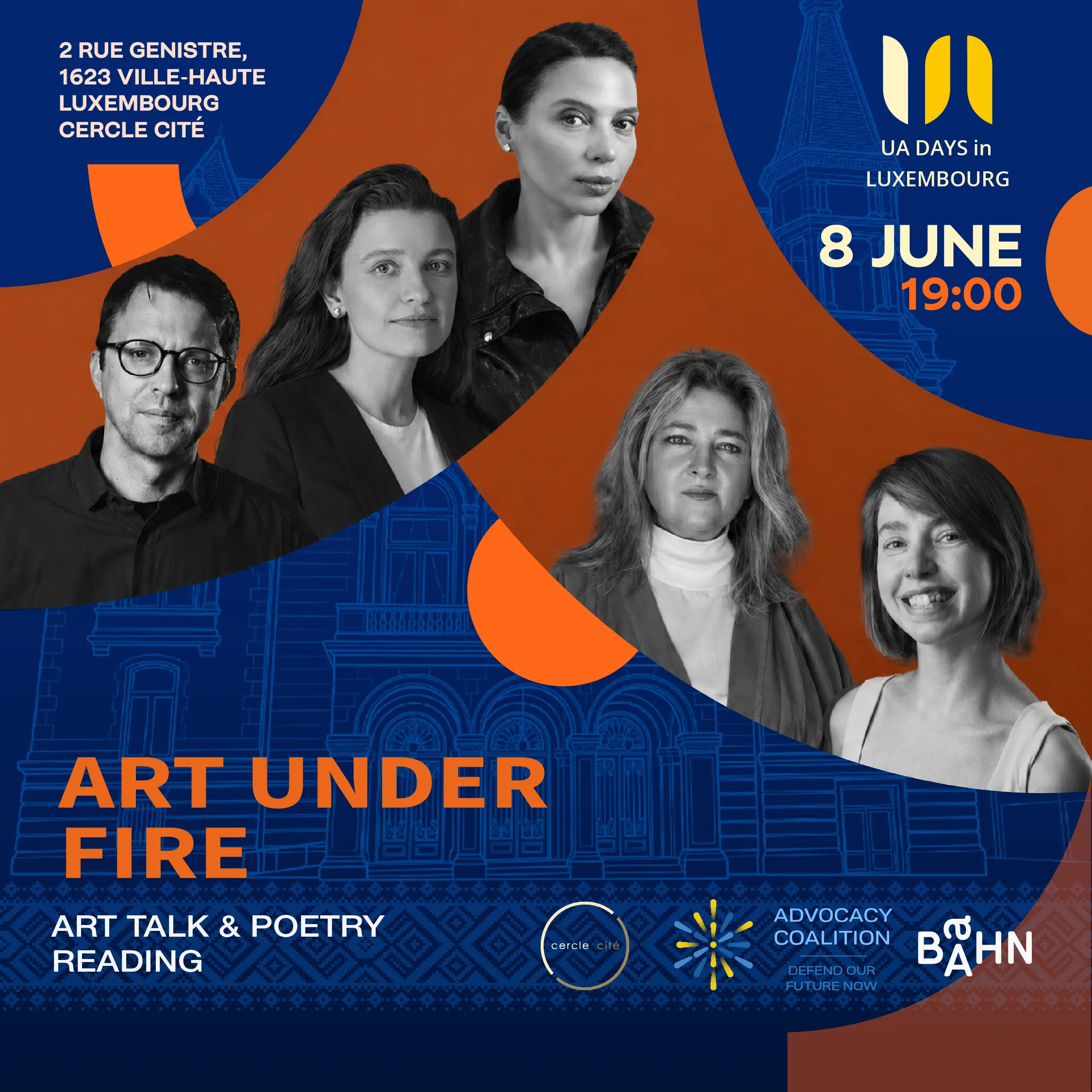
This evening brings together a round table and poetry readings with participants working across literature, cinema, curatorial practice, and cultural production, connecting voices from Ukraine and across Europe.
At the centre of the conversation is the role of art in times of war: how it responds to violence, carries memory, and continues under pressure, as well as its limits — what it can express or make visible when ordinary language is no longer sufficient.
Iryna Tsilyk is a filmmaker, writer, and screenwriter based in Kyiv. Her documentary The Earth Is Blue as an Orangereceived the Directing Award at the Sundance Film Festival and the Shevchenko National Prize. Working across documentary, fiction, and animation, she explores everyday life shaped by war, while her literary work and essays extend this perspective into a broader cultural and international context.
Irena Karpa is a writer, musician, and public intellectual, known as one of the most distinctive voices in contemporary Ukrainian culture. Her work moves between literature, music, and media, combining directness, irony, and sharp social observation, while engaging with themes of identity, freedom, and life during war. She is also активно involved in cultural diplomacy, working between Kyiv and Paris.
Marion Guth is a Luxembourg-based producer working across feature films, documentaries, animation, and immersive formats. As co-founder of a_BAHN, she develops internationally oriented projects that move between cinema and XR. Her work includes politically engaged productions such as Zero Impunity and the animated project Red Zone, and reflects a sustained interest in how storytelling intersects with technology, collaboration, and contemporary political realities.
Marta Czyż is an art historian, independent curator, and critic, and curator of the Polish Pavilion at the 60th Venice Biennale. Her work focuses on contemporary art, archives, and the visual representation of conflict, with particular attention to Ukrainian art and to how images and exhibitions shape the understanding of war, memory, and social change. In Luxembourg, together with the Ukrainian collective Open Group, she also presented the installation Repeat After Me II at Konschthal Esch, on view until 20 September 2026.
Radek Lipka contributes a perspective shaped by film curation and international cultural programming, working at the intersection of cinema and public discourse.
The evening concludes with poetry readings by Philippe Schockweiler, where the themes of the discussion take on a more direct and concentrated form.
Together, the discussion and readings situate art within the conditions of war, reflecting the central idea of the festival: culture continues under pressure and remains part of what is being defended today.