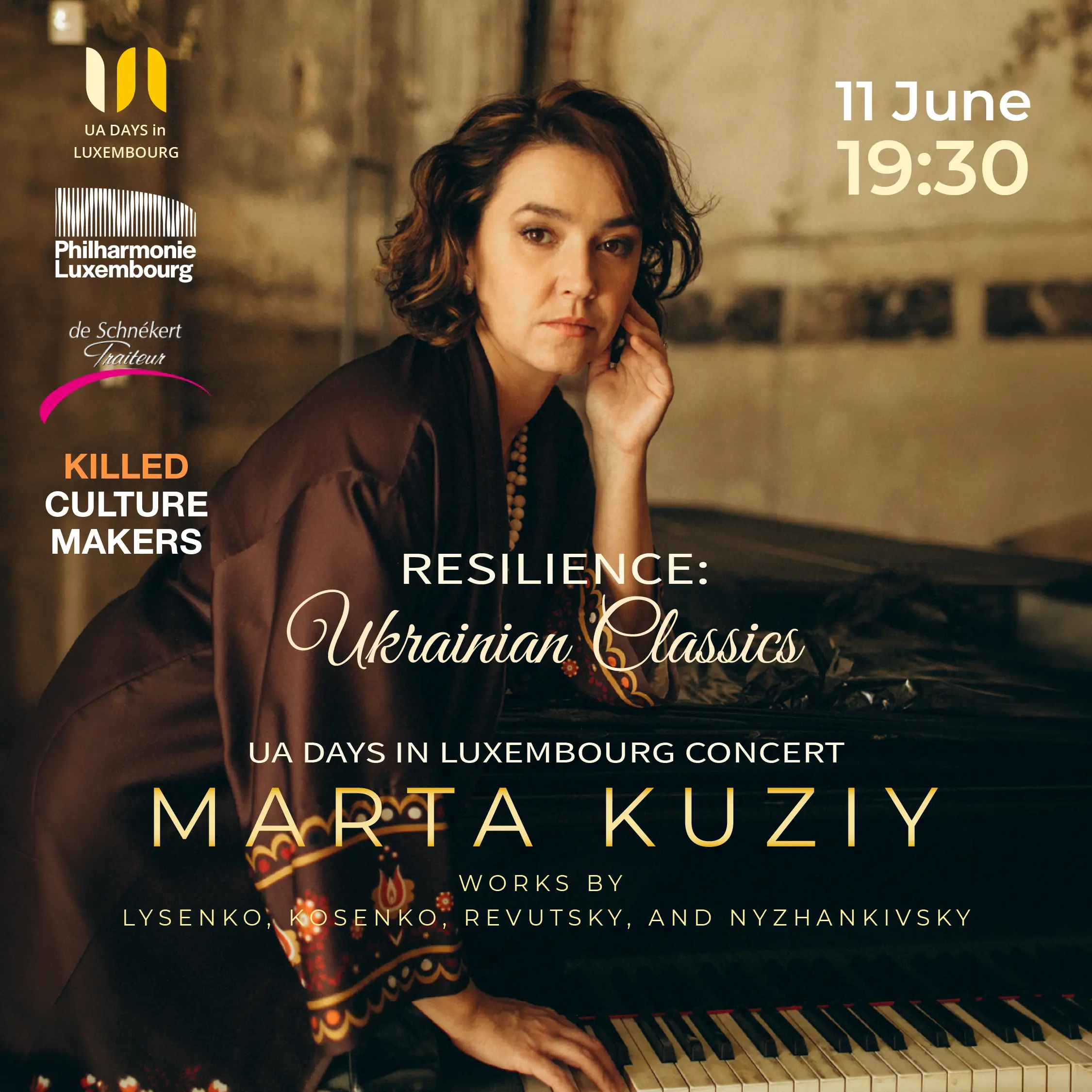
At its centre is pianist Marta Kuziy — a performer, educator, and cultural ambassador whose work moves between Ukraine and the wider European cultural space. Born in Lviv, she began studying piano at the age of four and was trained within the Ukrainian classical tradition before continuing her artistic development in Poland. Her formation brings together strong academic grounding, international experience, and a sustained engagement with Ukrainian repertoire.
Over the past years, her work has taken on a particular focus. Returning to Ukraine in 2019 after more than a decade abroad, she continues to perform internationally while actively contributing to cultural life within Ukraine. Alongside her concert activity, she teaches and works with young musicians, shaping a new generation for whom music is not only a profession, but a way of thinking and responding to the present.
In this context, her artistic practice reflects a broader condition. Ukrainian music today exists in a reality shaped by war, where culture itself is under direct threat. Through her interpretations, this music is not presented as heritage alone, but as a living cultural language — one that preserves memory, sustains continuity, and remains present within the European cultural space.
The programme brings together works by Mykola Lysenko, Viktor Kosenko, Levko Revutsky, and Nestor Nyzhankivsky.
Mykola Lysenko (1842–1912)
A foundational figure of Ukrainian music, Lysenko established a national compositional language rooted in both European form and Ukrainian musical tradition. His work laid the foundation for a cultural identity that continues to develop today.
Viktor Kosenko (1896–1938)
Kosenko’s music is marked by lyricism, sensitivity, and inner depth. His works bring an intimate and human dimension, where expression remains precise and emotionally clear.
Levko Revutsky (1889–1977)
Revutsky works through restraint, balance, and inner tension. His music reveals a strength that emerges through structure rather than excess.
Nestor Nyzhankivsky (1893–1940)
Nyzhankivsky’s work engages with European compositional traditions while maintaining a distinct and individual voice. His music combines clarity, structure, and a strong sense of identity.
Together, these composers present Ukrainian music as part of a broader European cultural space – not separate from it, but formed in continuous dialogue with it. Their works remind us that this war is fought not only over territory, but over memory, identity, and culture.
Alongside the music, the concert integrates the stories of Ukrainian cultural figures killed by Russia, developed in collaboration with Killed Culture Makers. This creates a clear contrast between music that continues to be heard and voices that were deliberately silenced.
This concert presents Ukrainian classical music in the context in which it exists today – under the conditions of war. In a reality where Russia targets not only cities and lives, but also culture, music becomes a way to preserve memory, maintain continuity, and remain present. In this sense, supporting Ukrainian music today is not only an act of solidarity, but part of a broader commitment to protecting culture, truth, and freedom in Europe.
Programme:
Mykola Lysenko (1842 – 1912)
• Sonata in A minor, Op. 16 – 21’
• Concert Polonaise No. 2, Op. 7 -7’
• Second Rhapsody on Ukrainian Themes “Dumka–Shumka,” Op. 18 – 7’
Viktor Kosenko (1896 – 1938)
• Étude, Op. 8 No. 8 – 5’
• Mazurka, Op. 9 – 5’
• Poem-Legend, Op. 12 No. 1 – 2’
Levko Revutsky (1889 – 1977)
• Song, Op. 17 No. 1 – 3’
• Preludes, Op. 4 Nos. 1-2 – 4’
Nestor Nyzhankivsky (1893 – 1940)
• Prelude and Fugue – 5’
• Waltz – 2’